Maintainer notes
AI at the edge of the edge — thoughts from ZDS 2024
TinyML on constrained Zephyr devices at ZDS 2024, including Beefy ML on CERES TAG.
2024-05-15 · Jordan Yates
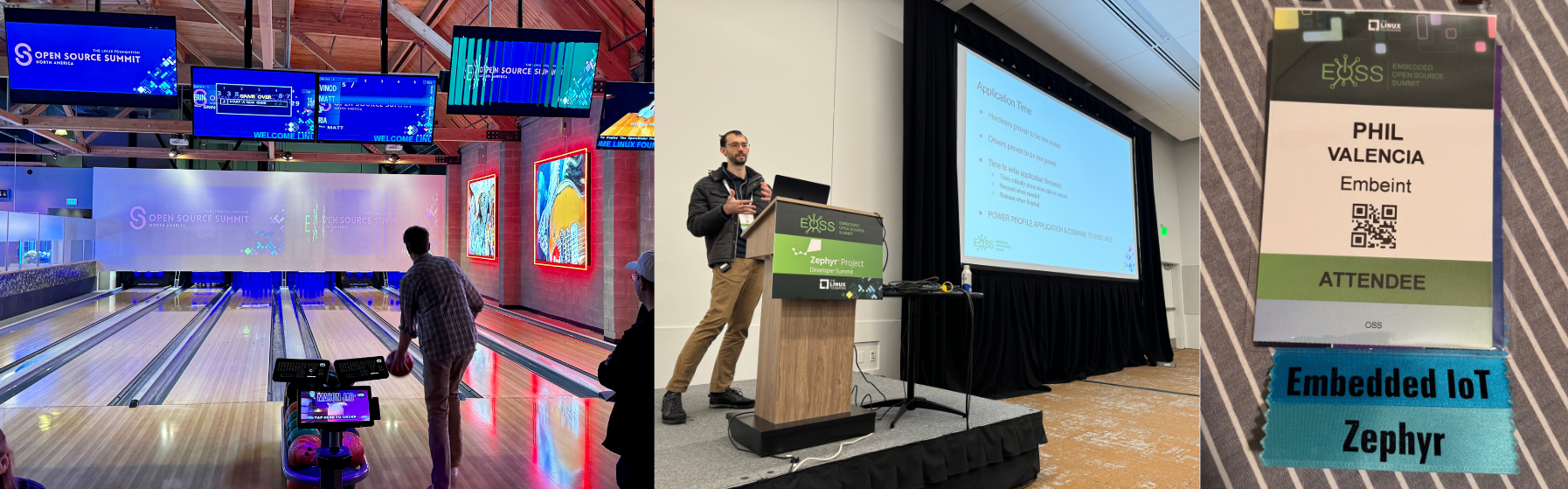
ZDS is always a great networking event with loads of interesting talks (Seattle, WA)
This was my second year at the Zephyr Developer Summit (ZDS). Once again it didn't disappoint in delivering great talks, great networking, and a snapshot of the great progress and future plans for The Zephyr Project embedded RTOS.
I was a little surprised, however, that AI/ML didn't make a stronger showing at ZDS though. I was fortunate enough to get to CES earlier this year and everyone was talking about "pushing AI/ML to the edge". Perhaps having spent so much of my career around the "embedded intelligence" area, I just expected to see ML running on many Zephyr devices by now. But it was clear that ML for this "embedded edge" (i.e. untethered IoT) is still in its very early days with Zephyr developers.
I guess it's reasonable — the required combination of data scientists with knowledge of deep ML for constrained devices and experienced embedded (low power) Zephyr developers is not that common yet.
Nonetheless, @Embeint (opens in a new tab)’s @jordan (opens in a new tab) presented Beefy ML on the work done at @CSIRO that adds great capability and value to the @ceres (opens in a new tab) ear tag devices for classifying animal behaviour.
Another embedded ML talk I enjoyed was from @Benjamin Cabé (opens in a new tab), The Linux Foundation, on his "weekend hack" in getting TinyML running for an "electronic nose":
▶ Watch: TinyML Electronic Nose Demo (opens in a new tab)
▶ Watch: TinyML Electronic Nose Demo - Part 2 (opens in a new tab)
The magic that really enables the ML for Ben's demo was done by @EdgeImpulse (opens in a new tab). I was lucky enough to meet a fair few of the crew during the event.
This is certainly a game changer for embedded AI practitioners (aka Data Scientists), and in fact opens up ML creation for embedded devices to a broader (less AI-savvy) developer audience.
However, despite Ben's rapid outcome on the electronic nose, creating ML for devices on ultra-low-power objects for commercial applications is still quite the feat — requiring logging and annotation of data, and deep knowledge of the MCU (and features) in order to create a ML model that can inference low power and run within all the constraints of a low power, low cost microcontroller.
At Embeint, we believe in the vision of a world where Ambient Intelligence transforms the way people live and work. To reach that, however, we need to continue to simplify the creation of ultra-low-power ML/AI-enabled, LPWAN IoT devices — so that intelligence can be embedded into everyday objects.
And this is what Embeint are going all in on (love that All-In podcast (opens in a new tab) btw).
That's not to say that cloud or powered edge won't have some great genAI that infers on the "big picture" to solve problems and provide unprecedented context that adds massive value and efficiencies — it's just not the problem we're focusing on initially.
Other Talks I Enjoyed (Outside of ML, but potentially still related to our vision)
ZBUS
by Rodrigo Peixoto, Edge-UFAL / Citrinio
A great pub/sub framework for connecting data generators to data consumers. Very versatile and something we'll be looking to leverage.
▶ Watch: ZBUS - A Publish-Subscribe Framework for Zephyr (opens in a new tab)
MicroPython
by Ryan Erickson, Ezurio
Demoed the cool high-level application code of MicroPython running on very resource-constrained devices.
▶ Watch: Build Wireless Products Faster with Zephyr and MicroPython (opens in a new tab)
LLEXT (Linkable Loadable Extensions)
by Cedric Lescop, Schneider Electric
and Tom Burdick, Intel
(btw Tom I did think of Lloyd the Llama to look for your talk but didn’t get much hits — hoping this post helps the SEO on that one!)
▶ Watch: Extending Zephyr Applications at Runtime with llext (opens in a new tab)
▶ Watch: Extending Zephyr Applications at Runtime with llext - Part 2 (opens in a new tab)
In Conclusion
There were lots of other talks on new and future features of Zephyr which I don’t have time to detail in this blog — but to summarise, it was great to see the vibrant Zephyr community continuing to gain speed in improving and adding to the Zephyr Project.
Hope to see you at the next ZDS!